Free · No account · Any road on Earth

The same road. The same minute. The same sun.

Scroll. This is the drive eastbound at sunrise in Detroit, today.

It happens where it always happens.

The sun rises to the minute, in a known direction. The road you take simply points at it for a while. Nobody planned that. Nobody has to be surprised by it either.

7:31 AM. Sun 4° above the road.

If you are squinting at this sentence, that is the feeling. From here until 7:59 AM, on this heading, most mornings this month.

Same drive, October 21. Still dark.

By then sunrise has slid to 7:55 AM, after you have parked. Nothing about the road changed. The calendar moved the sun.

Look once before you go.

Where the sun will sit in your windshield, for how long, and which minute would have been kinder. Glare reads it for the route you already know.
Keep scrolling ↓

01 / The reason to look ahead

Replace the guess you have made a hundred times.

You already know the turn where the sun gets you. What you do not know is the minute, or whether today is one of the days. Glare connects the sun's position to the route you know, so the glare window is something you can read before you leave.

  • 01Route, not region. Each stretch is judged on its own heading, at the time you will actually be on it.
  • 02Your car. A sedan, SUV or pickup changes how low the sun must be before the visor stops helping.
  • 03Clouds, separately. The geometry is certain. The forecast is a forecast. They are never blended.

A clear read, not a promise of a clear windshield.

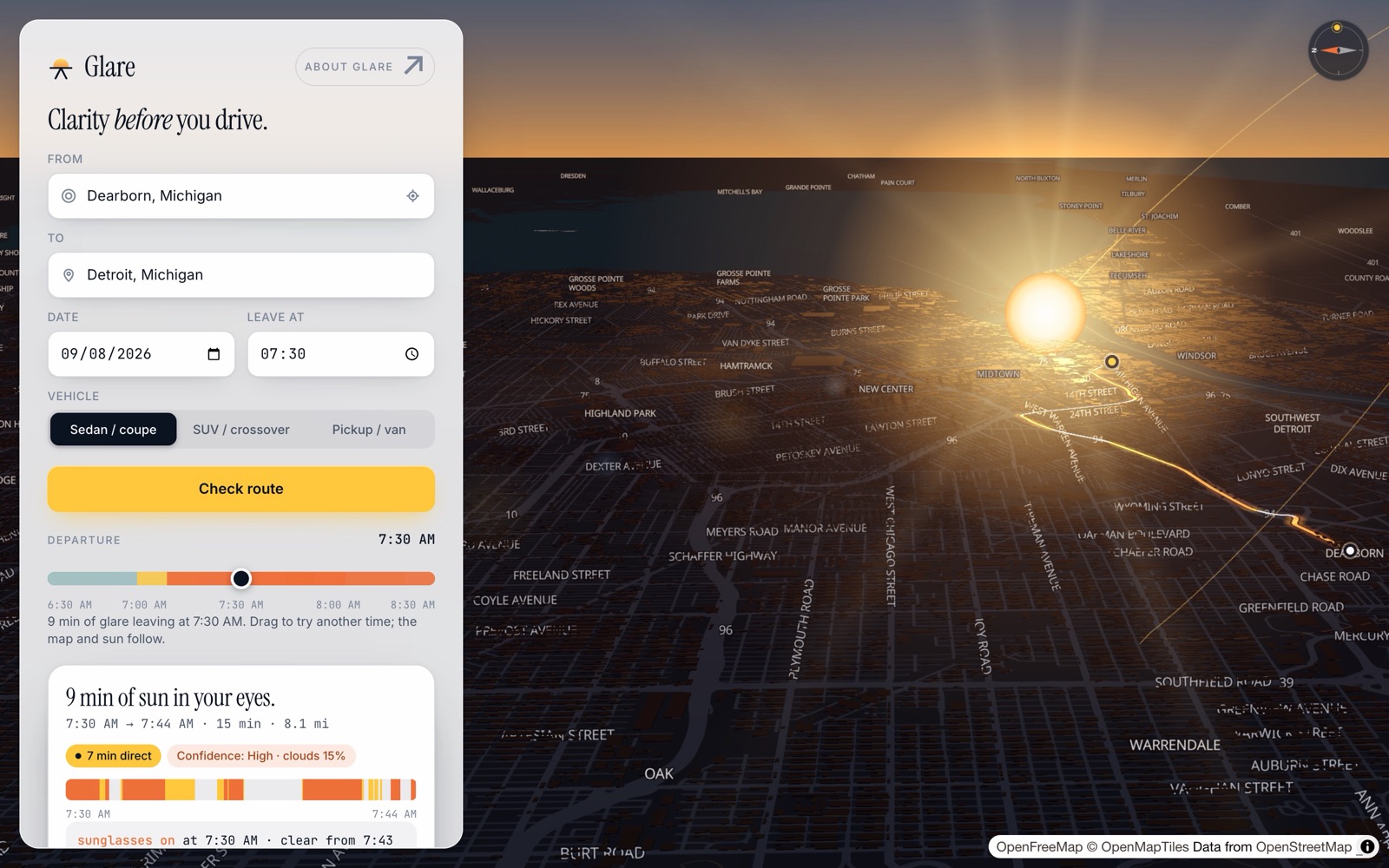
Glare showing a sunrise route from Dearborn to Detroit with nine minutes of sun in the driver's eyes

Before the familiar turnLow sun can change the feel of a known road.

02 / A clearer look

Know the moment before it arrives.

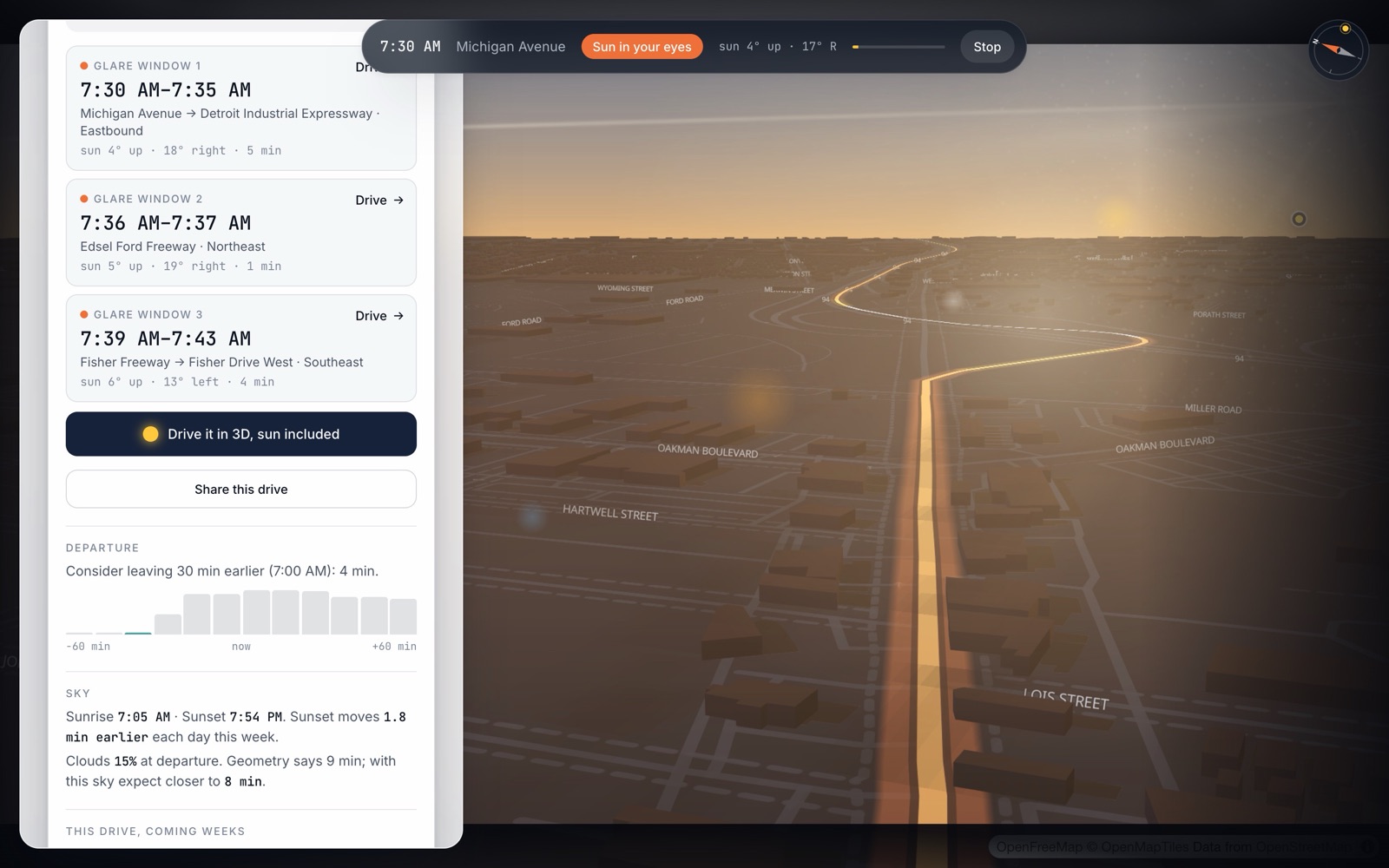
A driver's-eye run along your route with the real sun in the glass. It washes in, a tower blocks it for a few seconds, it comes back. The stretch is familiar before you are in it.

7:32 AM · Edsel Ford Fwy · sun 4° up, 15° right · sunglasses on

Driver's-eye view in Glare with the low sun washing the windshield
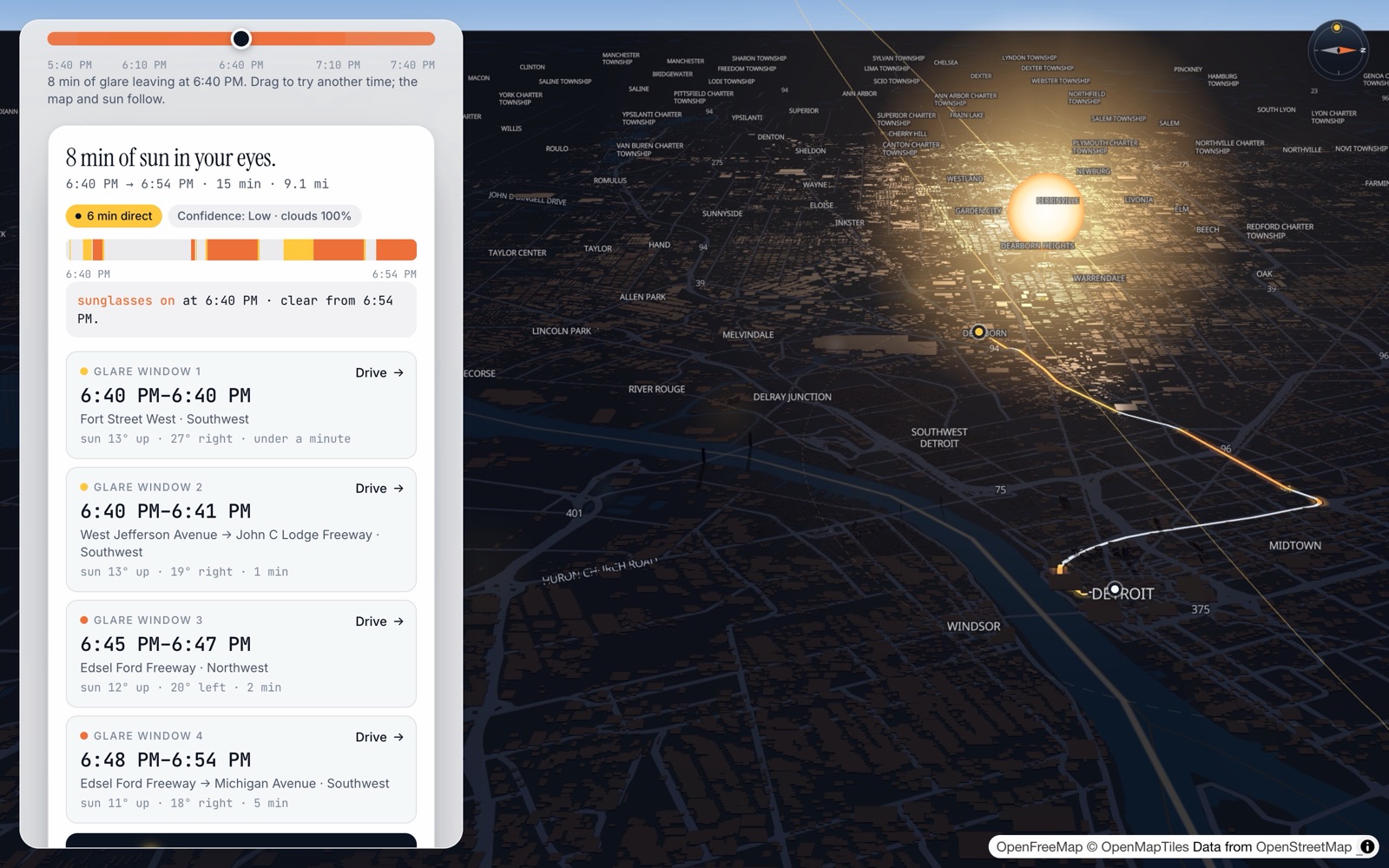
Glare's departure scrubber and coming-weeks forecast

03 / The other minute

Twenty minutes later, it is a different road.

Drag the departure and the sun moves with it while the route recolours. The same drive is scored for the next seventy days, so a daily commute knows its own season: sun in your eyes until October 11, then clear until the clocks change.

  • The kinder departure within 30 or 60 minutes, in one line.
  • The coming weeks as a strip you can read at a glance.
  • Hand-off to Apple Maps or Google Maps for the drive itself.

04 / Something to send

The whole day's sun, and your ten minutes of it.

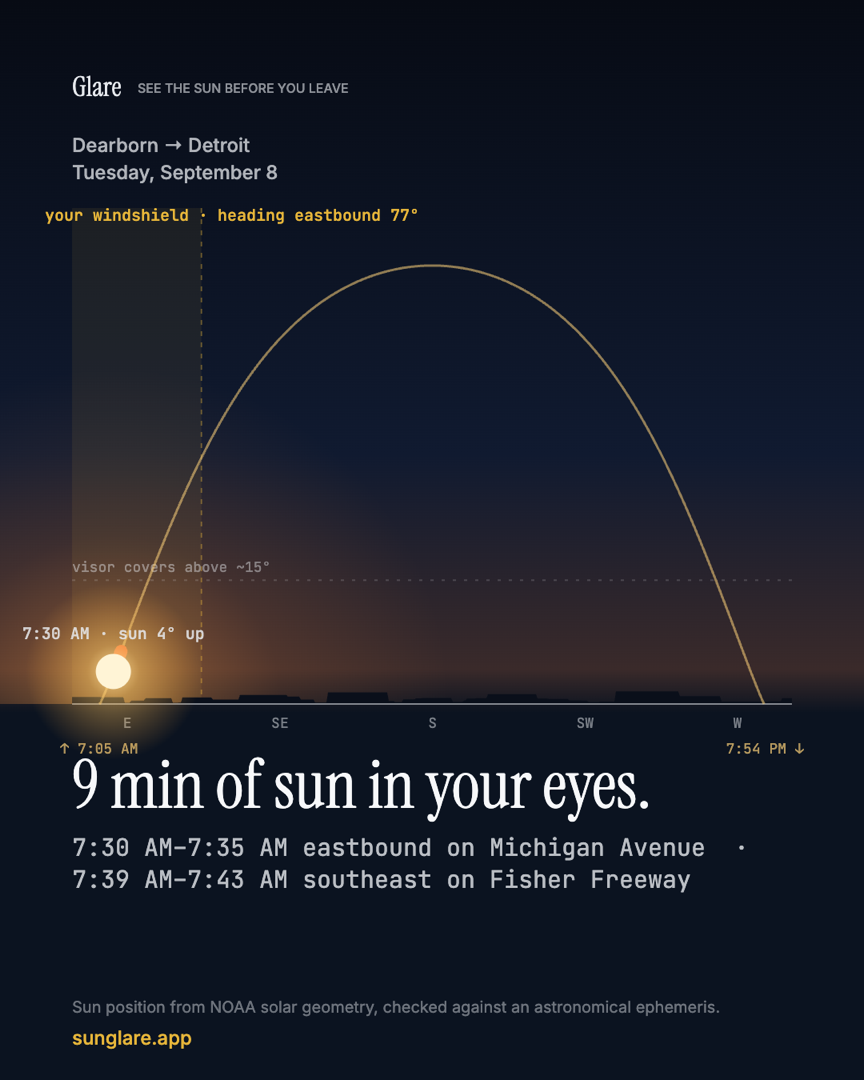
One card: today's arc over the skyline of your route, your trip marked on it, the windshield at your heading. Send it to whoever drives the same road.

Glare share card: the sun's arc over Detroit with the trip window highlighted

05 / What exact means

Numbers you can check.

0
sun position against an astronomical ephemeris (NOAA solar geometry, all refraction terms)
0
sunrise and sunset, checked on an equinox and a solstice date
0
days ahead scored for the same drive, across the clock change
sunset drift each day this week

What Glare does not model, said plainly inside the app: hills, buildings and trees that block the sun beyond the ones we draw, other vehicles, live traffic. Times come from routing without traffic, so on a congested road the window can drift a few minutes, and near sunrise the sun moves about 2.5° every ten minutes. That is why the clouds line and the geometry line are always two sentences, never one.

06 / Three steps

Start with a route you already know.

01

Type the drive.

From, to, when you leave, what you drive. No account. Nothing is kept anywhere but your browser.

02

Read the window.

Which stretch, from when to when, and where the sun sits against your heading.

03

Choose the minute.

Leave a little later, take the calmer route, or just put the sunglasses on the passenger seat. The decision stays yours.

On your phone

Works in the car park, before you pull out.

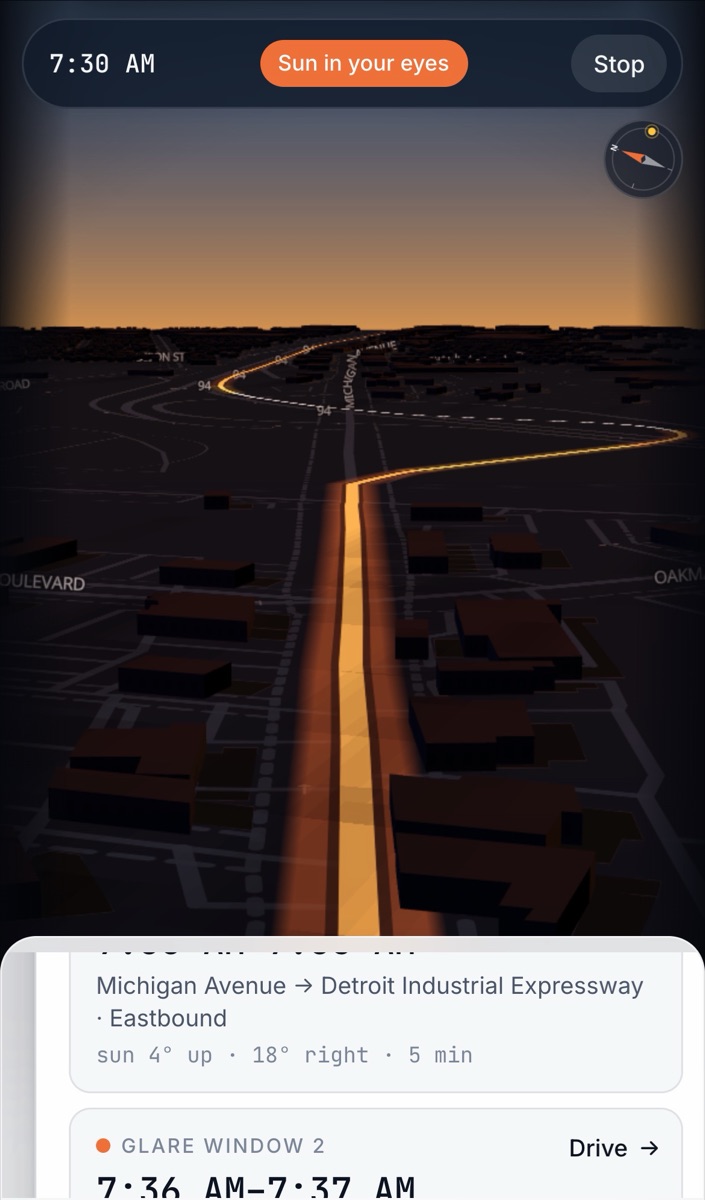
Open sunglare.app before you leave. The drive view runs in any modern phone browser.

Glare drive view on an iPhone

For the drives you already know

Low sun is a schedule problem, not a weather problem.

The same commute is fine in July and blinding in late September, because sunrise slides into your departure time. An eastbound morning drive, a westbound evening drive, the school run at 7:40, the airport road at dusk: Glare tells you the minutes the sun will be in your eyes and the date it stops.

  • Morning commuters heading east, especially in the weeks around the equinoxes.
  • Evening drives heading west, when a low sun sits right above the road.
  • Delivery and rideshare drivers planning a shift around the glare window.
  • Anyone who has said "the sun was in my eyes" once too often.

07 / Questions

The ones people ask first.

How can it be accurate? There are so many factors.

Two kinds of factor. The sun's position is pure geometry and is exact; we verify it against an astronomical ephemeris and print the number. Everything else (your car, clouds, hills, traffic) is either modelled with its assumption shown, or stated as not modelled. The app never hides a guess behind a certain-sounding number.

Does my car's height or ground clearance matter?

Less than you'd think. The sun is effectively infinitely far away, so seat height doesn't change its angle. What differs between cars is how far down the lowered visor covers, which depends on windshield rake and seating. That's the vehicle setting. Ground clearance doesn't enter into it.

Sunset here is getting earlier fast. Do you account for that?

It falls straight out of the math. Glare computes today's sunrise and sunset for your route and shows the day-to-day drift, which is why the coming-weeks forecast can tell you the exact date a commute goes clear.

Is it free? What do you collect?

Free, no account, no tracking of your routes. Addresses are geocoded by open services as you type; nothing is stored on a server of ours because there isn't one.

Where does it work?

Anywhere with roads in OpenStreetMap, which is nearly everywhere. Distances follow your language setting, miles or kilometres.

See the sun. Plan the drive. Own the time.

Look once before you go.

Check your route

Made by

Sai Dileep Kumar Mukkamala

Built in Detroit, for a morning drive east on Michigan Avenue that kept catching the sun at the same minute every September. Glare is free and stays that way; questions and ideas are welcome.

Connect on LinkedIn